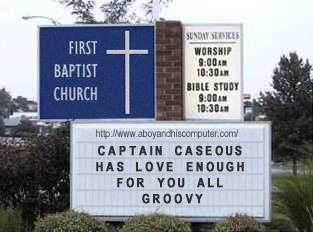
søndag, mars 16, 2003

Nulla Verba

Well, the Captain's ship & crew is off to Rummy's Olde Europe. We'll see what the situation is ourselves and report back at the start of April. Until then, good luck to all. If someone starts a war, you know we'll be doing what we can to be part of stopping it and we hope you will, too. Bush may start his war, but it's clear that we can and will end it. Keep an eye out for indie media (check out cursor.org) for some perspective if this country goes wall to wall CNN. And, most of all, peace.


CCF

One last perspective for March...one that a lot of people are working hard not to see...

What About the Iraqi Children?

Charlotte Aldebron, WireTap
March 3, 2003
Viewed on March 16, 2003

The following is a transcript of a speech given by now 13-year-old Charlotte Aldebron at a peace rally in Maine.


When people think about bombing Iraq, they see a picture in their heads of Saddam Hussein in a military uniform, or maybe soldiers with big black mustaches carrying guns, or the mosaic of George Bush Senior on the lobby floor of the Al-Rashid Hotel with the word "criminal." But guess what? More than half of Iraq's 24 million people are children under the age of 15. That's 12 million kids. Kids like me. Well, I'm almost 13, so some are a little older, and some a lot younger, some boys instead of girls, some with brown hair, not red. But kids who are pretty much like me just the same. So take a look at me -- a good long look. Because I am what you should see in your head when you think about bombing Iraq. I am what you are going to destroy.


If I am lucky, I will be killed instantly, like the three hundred children murdered by your "smart" bombs in a Baghdad bomb shelter on February 16, 1991. The blast caused a fire so intense that it flash-burned outlines of those children and their mothers on the walls; you can still peel strips of blackened skin -- souvenirs of your victory -- from the stones.


But maybe I won't be lucky and I'll die slowly, like 14-year-old Ali Faisal, who right now is in the "death ward" of the Baghdad children's hospital. He has malignant lymphoma -- cancer -- caused by the depleted uranium in your Gulf War missiles. Or maybe I will die painfully and needlessly like18-month-old Mustafa, whose vital organs are being devoured by sand fly parasites. I know it's hard to believe, but Mustafa could be totally cured with just $25 worth of medicine, but there is none of this medicine because of your sanctions.


Or maybe I won't die at all but will live for years with the psychological damage that you can't see from the outside, like Salman Mohammed, who even now can't forget the terror he lived through with his little sisters when you bombed Iraq in 1991. Salman's father made the whole family sleep in the same room so that they would all survive together, or die together. He still has nightmares about the air raid sirens.


Or maybe I will be orphaned like Ali, who was three when you killed his father in the Gulf War. Ali scraped at the dirt covering his father's grave every day for three years calling out to him, "It's all right Daddy, you can come out now, the men who put you here have gone away." Well, Ali, you're wrong. It looks like those men are coming back.


Or I maybe I will make it in one piece, like Luay Majed, who remembers that the Gulf War meant he didn't have to go to school and could stay up as late as he wanted. But today, with no education, he tries to live by selling newspapers on the street.


This is not an adventure movie or a fantasy or a video game. This is reality for children in Iraq.

Imagine that these are your children -- or nieces or nephews or neighbors. Imagine your son screaming from the agony of a severed limb, but you can't do anything to ease the pain or comfort him. Imagine your daughter crying out from under the rubble of a collapsed building, but you can't get to her. Imagine your children wandering the streets, hungry and alone, after having watched you die before their eyes.


This is not an adventure movie or a fantasy or a video game. This is reality for children in Iraq. Recently, an international group of researchers went to Iraq to find out how children there are being affected by the possibility of war. Half the children they talked to said they saw no point in living any more. Even really young kids knew about war and worried about it. One 5-year-old, Assem, described it as "guns and bombs and the air will be cold and hot and we will burn very much." Ten-year-old Aesar had a message for President Bush: he wanted him to know that "A lot of Iraqi children will die. You will see it on TV and then you will regret."


Back in elementary school I was taught to solve problems with other kids not by hitting or name-calling, but by talking and using "I" messages. The idea of an "I" message was to make the other person understand how bad his or her actions made you feel, so that the person would sympathize with you and stop it. Now I am going to give you an "I" message. Only it's going to be a "We" message. "We" as in all the children in Iraq who are waiting helplessly for something bad to happen. "We" as in the children of the world who don't make any of the decisions but have to suffer all the consequences. "We" as in those whose voices are too small and too far away to be heard.


We feel scared when we don't know if we'll live another day.


We feel angry when people want to kill us or injure us or steal our future.


We feel sad because all we want is a mom and a dad who we know will be there the next day.


And, finally, we feel confused -- because we don't even know what we did wrong.


Charlotte Aldebron, 13, attends Cunningham Middle School in Presque Isle, Maine. Comments may be sent to her mom, Jillian Aldebron at aldebron@ainop.com.


lørdag, mars 15, 2003

Diplomacy?

On the news, I keep hearing how the Summit in the Azores represents Bush going the last mile for Diplomacy in order to avoid war. Excuse me, bu that's bullshit. He's been trying (very ineptly, I might add) to convince an unwilling world to go to war, not make peace. He's been trying to buy votes in order to get enough countries to pass a new resolution authorizing force. Now that he knows he's failed, he's making plans to ignore the UN and world opinion for...oh, I don't know...the millionth fucking time?!!! Once again, our media can't seem to tell it like it is!

fredag, mars 14, 2003

The Arrested The Easter Bunny For Protesting Military-Themed Baskets

Read about it here.
From Mother Jones:

"But while the companies hope to cash in on an American-controlled Iraq, the push to remove Saddam Hussein hasn't been driven by oil executives, many of whom are worried about the consequences of war. Nor are Vice President Cheney and President Bush, both former oilmen, looking at the Gulf simply for the profits that can be earned there. The administration is thinking bigger, much bigger, than that.

"Controlling Iraq is about oil as power, rather than oil as fuel," says Michael Klare, professor of peace and world security studies at Hampshire College and author of Resource Wars. "Control over the Persian Gulf translates into control over Europe, Japan, and China. It's having our hand on the spigot.""
Down The Memory Hole

"Those wonderful troublemakers at Unknown News have caught the "newspaper of record" changing the record. On 15 February 2003, the New York Times Website ran an article on the worldwide peace protests held that day. The last paragraph reported that the NY Police Department had snipers on the rooftops and undercover officers in the crowd.

For the next day's edition, that article was replaced with another version. The new version was mostly the same as the old. The second part of the title had been changed, and a few new paragraphs had been added. But most important is what was removed."

torsdag, mars 13, 2003

From >TBOGG

"I bought gas this morning at the local Shell Station.

Regular $2.42 9/10
Super $2.52 9/10
Premium $2.62 9/10

But the good news is that no one is getting blowjobs in the White House."
We Have Become Parodies Of Ourselves

Lawmaker Wants Troops' Remains Back From France
By ANDY REID

BROOKSVILLE - Forget dumping champagne, boycotting brie or sailing the Statue of Liberty back to Paris.

Frustrated by France's refusal to support a war with Iraq, U.S. Rep. Ginny Brown- Waite proposes bringing the remains of American veterans buried in France back to the United States.

More here.
No Problems With That Patriot Act, No Sir!

"WASHINGTON
March 13

Government agencies opened a package mailed between two Associated Press reporters last September and seized a copy of an eight-year-old unclassified FBI lab report without obtaining a warrant or notifying the news agency.

The Customs Service intercepted a package sent via Federal Express from the Associated Press bureau in Manila to the AP office in Washington, and turned the contents over to the FBI.

FBI spokesman Doug Garrison said the document contained sensitive information that should not be made public. However, an AP executive said the package contained an unclassified 1995 FBI report that had been discussed in open court in two legal cases.

"The government had no legal right to seize the package," said David Tomlin, assistant to the AP president.

The package was one of several communications between Jim Gomez in Manila and John Solomon in Washington, AP reporters who were working on terrorism investigative stories.

It was the second time that Solomon's reporting was the subject of a government seizure. In May 2001 the Justice Department subpoenaed his home phone records concerning stories he wrote about an investigation of then-Sen. Robert Torricelli.

The Customs Service said its agents opened the package from Manila after selecting it for routine inspection when it arrived at a Federal Express hub in Indianapolis. Agents did not open an identical package addressed to AP's United Nations office.

Both packages contained an FBI laboratory report on materials seized from a Filipino apartment rented by convicted terrorist Ramzi Yousef. The reporters were working on a research project that resulted in stories published last month about the government's concerns before April 19, 1995, that white supremacists might bomb a federal building.

"The job of Customs is to intercept smuggled contraband and collect import duties," said Tomlin, who is an attorney. "Customs has no authority to seize private correspondence where there's no suspicion it contains contraband. There certainly wasn't any such suspicion here."

Press freedom advocates criticized the agencies' seizure of the document.

"It was really stupid of them to keep it," said Lucy Dalglish, director of the Reporters Committee for Freedom of the Press. "What they're trying to do is prevent you from reporting a story. That's censorship."

The AP inquired about the missing FedEx package last autumn when it did not arrive in Washington, and the courier suggested it might have fallen off a delivery van. FedEx later reimbursed AP $100 for the loss.

FedEx spokeswoman Sally Davenport said Wednesday the company was unable to track the package after it arrived in Indianapolis and had no records showing that it was seized by Customs. If the company knows a package has been taken by Customs, FedEx policy is to notify the customer and provide a number to contact the agency, Davenport said. FedEx did send a letter of apology to the AP, she said.

In January the AP was tipped that the package had been intercepted and that the FBI had requested an investigation to find out who had provided the lab report to the news service.

A letter from the Philippine Department of Justice to the Philippine National Police about the document read, in part: "In view of the concerns raised by the FBI regarding this matter, may we request your good office to conduct a thorough investigation on the mishandling of such sensitive information?"

Customs has the legal right to examine packages sent from overseas at the point they arrive in the United States, in this case Indianapolis. The Customs Service (now the Bureau of Customs and Border Protection) said in a statement that the package addressed to Solomon was selected for "routine inspection" on Sept. 19. Because it contained an FBI document, Customs called the FBI. Spokesman Dean Boyd said Customs routinely asks another agency about contents of an examined package that pertain to that agency.

"An FBI agent subsequently examined the file and requested that it be turned over to the FBI," the Customs statement said. "Based upon these representations by the FBI, Customs turned the file over."

No warrant was issued, Customs and FBI both said. Customs said any notification to the AP was the FBI's responsibility.

Garrison, who works out of the FBI's Indianapolis bureau, said the package was sent to the FBI in Washington after an FBI agent in Indianapolis reviewed the document and said it contained some information that should not be made public.

"From the FBI's perspective, if the document was a laboratory report that contained sensitive information that the laboratory thought ought to be controlled, they had an obligation to control it," Garrison said. "Generally speaking, we're more careful about the kind of information that's out there. We don't want criminals to get ideas as to how to cause more damage."

The AP said the information had been previously publicly disclosed in two court venues. The material included copies and photos of dozens of pieces of evidence gathered in the terrorism cases of Abdul Hakim Murad and Ramzi Yousef, including batteries, explosive devices, bomb fragments, a copy of a Time magazine, cell phones and phone books.

Murad and Yousef were sentenced to life in prison in a plot to blow up 12 U.S.-bound airliners flying out of Asia. Yousef was later convicted of masterminding the 1993 World Trade Center bombing.

The earlier incident involving Solomon's home phone records sparked a media outcry after Justice officials subpoenaed Solomon's phone records while trying to learn the identity of law enforcement officials who told the AP about a wiretap intercept of then-Sen. Torricelli of New Jersey.

Solomon found out about the May 2001 subpoena in August when he returned from vacation and opened a notification letter from the government. The Code of Federal Regulations says the AP should have had the opportunity to challenge the subpoena.


Copyright 2003 The Associated Press. All rights reserved. This material may not be published, broadcast, rewritten, or redistributed.
Copyright ? 2002 ABC News Internet Ventures.
Click here for Press Information, Terms of Use & Privacy Policy & Internet Safety Information applicable to the site."

When governments can abuse their power, they often will. Why the Patriot Act was allowed to be shoved through Congress so that these abuses could happen is a question we might want to think about asking.
I Wonder If Other Countires Ever Get Tired Of Being Embarrassed For Us

March 13, 2003 ?|? LTA, Wyo. (AP) -- Pressure from uncomfortable skiers and other tourists has prompted the Grand Targhee Ski and Summer Resort to cover the second half of the name of one of its mountains.

Mary's Nipple is now just Mary's, and signs with the word "nipple" have been covered with tape. New signs were to arrive in about two weeks.

But the covered signs have rankled some local skiers, who feel a bit of their history has been lost.

"If the name changed, it wouldn't be the same," said Mark Franklin of Driggs, Idaho, who has skied the mountain for 26 years without feeling offended. "It's always been Mary's Nipple to me, and probably 99.9 percent of the people around here will agree with me."

The name dates back three decades to a story about a waitress named Mary, who was working at Targhee's Trap Bar and streaked through it and the resort one night. The U.S. Forest Service has never acknowledged it officially.


- - - - - - - - - - - -
Sound Off
Send us a Letter to the Editor


Salon.com >> Life
?


Salon??Search??About Salon??Table Talk??Advertise in Salon??Investor Relations


News & Politics | Opinion | Tech & Business | Arts & Entertainment
Indie film | Books | Life | Sex | Comics | Audio | Dialogue
Letters | Columnists | Salon Gear


Reproduction of material from any Salon pages without written permission is strictly prohibited
Copyright 2003 Salon.com
Salon, 22 4th Street, 16th Floor, San Francisco, CA 94103
Telephone 415 645-9200 | Fax 415 645-9204
E-mail | Salon.com Privacy Policy | Terms of Service


Help Spread The Word!

Blogs took down Trent Lott. Now, Richard Perle has set himself up for a major backlash by trying to sue Seymour Hersh for writing about his business practices in The New Yorker this week. He's suing in Engalnd because he doen't have to prove much. Since he and Hersh are American citizens, Perle is essentially saying "fuck our laws." Should someone with so little faith in the Constitution be in his position? Please trade the story around, as this is the last thing that Perle wants but certainly deservers.

LUNCH WITH THE CHAIRMAN
by SEYMOUR M. HERSH
Why was Richard Perle meeting with Adnan Khashoggi?
Issue of 2003-03-17
Posted 2003-03-10


At the peak of his deal-making activities, in the nineteen-seventies, the Saudi-born businessman Adnan Khashoggi brokered billions of dollars in arms and aircraft sales for the Saudi royal family, earning hundreds of millions in commissions and fees. Though never convicted of wrongdoing, he was repeatedly involved in disputes with federal prosecutors and with the Securities and Exchange Commission, and in recent years he has been in litigation in Thailand and Los Angeles, among other places, concerning allegations of stock manipulation and fraud. During the Reagan Administration, Khashoggi was one of the middlemen between Oliver North, in the White House, and the mullahs in Iran in what became known as the Iran-Contra scandal. Khashoggi subsequently claimed that he lost ten million dollars that he had put up to obtain embargoed weapons for Iran which were to be bartered (with Presidential approval) for American hostages. The scandals of those times seemed to feed off each other: a congressional investigation revealed that Khashoggi had borrowed much of the money for the weapons from the Bank of Credit and Commerce International (B.C.C.I.), whose collapse, in 1991, defrauded thousands of depositors and led to years of inquiry and litigation.

Khashoggi is still brokering. In January of this year, he arranged a private lunch, in France, to bring together Harb Saleh al-Zuhair, a Saudi industrialist whose family fortune includes extensive holdings in construction, electronics, and engineering companies throughout the Middle East, and Richard N. Perle, the chairman of the Defense Policy Board, who is one of the most outspoken and influential American advocates of war with Iraq.

The Defense Policy Board is a Defense Department advisory group composed primarily of highly respected former government officials, retired military officers, and academics. Its members, who serve without pay, include former national-security advisers, Secretaries of Defense, and heads of the C.I.A. The board meets several times a year at the Pentagon to review and assess the country’s strategic defense policies.

Perle is also a managing partner in a venture-capital company called Trireme Partners L.P., which was registered in November, 2001, in Delaware. Trireme’s main business, according to a two-page letter that one of its representatives sent to Khashoggi last November, is to invest in companies dealing in technology, goods, and services that are of value to homeland security and defense. The letter argued that the fear of terrorism would increase the demand for such products in Europe and in countries like Saudi Arabia and Singapore.

The letter mentioned the firm’s government connections prominently: “Three of Trireme’s Management Group members currently advise the U.S. Secretary of Defense by serving on the U.S. Defense Policy Board, and one of Trireme’s principals, Richard Perle, is chairman of that Board.” The two other policy-board members associated with Trireme are Henry Kissinger, the former Secretary of State (who is, in fact, only a member of Trireme’s advisory group and is not involved in its management), and Gerald Hillman, an investor and a close business associate of Perle’s who handles matters in Trireme’s New York office. The letter said that forty-five million dollars had already been raised, including twenty million dollars from Boeing; the purpose, clearly, was to attract more investors, such as Khashoggi and Zuhair.


Perle served as a foreign-policy adviser in George W. Bush’s Presidential campaign—he had been an Assistant Secretary of Defense under Ronald Reagan—but he chose not to take a senior position in the Administration. In mid-2001, however, he accepted an offer from Secretary of Defense Donald Rumsfeld to chair the Defense Policy Board, a then obscure group that had been created by the Defense Department in 1985. Its members (there are around thirty of them) may be outside the government, but they have access to classified information and to senior policymakers, and give advice not only on strategic policy but also on such matters as weapons procurement. Most of the board’s proceedings are confidential.

As chairman of the board, Perle is considered to be a special government employee and therefore subject to a federal Code of Conduct. Those rules bar a special employee from participating in an official capacity in any matter in which he has a financial interest. “One of the general rules is that you don’t take advantage of your federal position to help yourself financially in any way,” a former government attorney who helped formulate the Code of Conduct told me. The point, the attorney added, is to “protect government processes from actual or apparent conflicts.”

Advisory groups like the Defense Policy Board enable knowledgeable people outside government to bring their skills and expertise to bear, in confidence, on key policy issues. Because such experts are often tied to the defense industry, however, there are inevitable conflicts. One board member told me that most members are active in finance and business, and on at least one occasion a member has left a meeting when a military or an intelligence product in which he has an active interest has come under discussion.

Four members of the Defense Policy Board told me that the board, which met most recently on February 27th and 28th, had not been informed of Perle’s involvement in Trireme. One board member, upon being told of Trireme and Perle’s meeting with Khashoggi, exclaimed, “Oh, get out of here. He’s the chairman! If you had a story about me setting up a company for homeland security, and I’ve put people on the board with whom I’m doing that business, I’d be had”—a reference to Gerald Hillman, who had almost no senior policy or military experience in government before being offered a post on the policy board. “Seems to me this is at the edge of or off the ethical charts. I think it would stink to high heaven.”

Hillman, a former McKinsey consultant, stunned at least one board member at the February meeting when he raised questions about the validity of Iraq’s existing oil contracts. “Hillman said the old contracts are bad news; he said we should kick out the Russians and the French,” the board member told me. “This was a serious conversation. We’d become the brokers. Then we’d be selling futures in the Iraqi oil company. I said to myself, ‘Oh, man. Don’t go down that road.’” Hillman denies making such statements at the meeting.

Larry Noble, the executive director of the Washington-based Center for Responsive Politics, a nonprofit research organization, said of Perle’s Trireme involvement, “It’s not illegal, but it presents an appearance of a conflict. It’s enough to raise questions about the advice he’s giving to the Pentagon and why people in business are dealing with him.” Noble added, “The question is whether he’s trading off his advisory-committee relationship. If it’s a selling point for the firm he’s involved with, that means he’s a closer—the guy you bring in who doesn’t have to talk about money, but he’s the reason you’re doing the deal.”

Perle’s association with Trireme was not his first exposure to the link between high finance and high-level politics. He was born in New York City, graduated from the University of Southern California in 1964, and spent a decade in Senate-staff jobs before leaving government in 1980, to work for a military-consulting firm. The next year, he was back in government, as Assistant Secretary of Defense. In 1983, he was the subject of a New York Times investigation into an allegation that he recommended that the Army buy weapons from an Israeli company from whose owners he had, two years earlier, accepted a fifty-thousand-dollar fee. Perle later acknowledged that he had accepted the fee, but vigorously denied any wrongdoing. He had not recused himself in the matter, he explained, because the fee was for work he had done before he took the Defense Department job. He added, “The ultimate issue, of course, was a question of procurement, and I am not a procurement officer.” He was never officially accused of any ethical violations in the matter. Perle served in the Pentagon until 1987 and then became deeply involved in the lobbying and business worlds. Among other corporate commitments, he now serves as a director of a company doing business with the federal government: the Autonomy Corporation, a British firm that recently won a major federal contract in homeland security. When I asked him about that contract, Perle told me that there was no possible conflict, because the contract was obtained through competitive bidding, and “I never talked to anybody about it.”


Under Perle’s leadership, the policy board has become increasingly influential. He has used it as a bully pulpit, from which to advocate the overthrow of Saddam Hussein and the use of preëmptive military action to combat terrorism. Perle had many allies for this approach, such as Paul Wolfowitz, the Deputy Secretary of Defense, but there was intense resistance throughout the bureaucracy—most notably at the State Department. Preëmption has since emerged as the overriding idea behind the Administration’s foreign policy. One former high-level intelligence official spoke with awe of Perle’s ability to “radically change government policy” even though he is a private citizen. “It’s an impressive achievement that an outsider can have so much influence, and has even been given an institutional base for his influence.”

Perle’s authority in the Bush Administration is buttressed by close association, politically and personally, with many important Administration figures, including Wolfowitz and Douglas Feith, the Under-Secretary of Defense for Policy, who is the Pentagon’s third-ranking civilian official. In 1989, Feith created International Advisors Incorporated, a lobbying firm whose main client was the government of Turkey. The firm retained Perle as an adviser between 1989 and 1994. Feith got his current position, according to a former high-level Defense Department official, only after Perle personally intervened with Rumsfeld, who was skeptical about him. Feith was directly involved in the strategic planning and conduct of the military operations against the Taliban in Afghanistan; he now runs various aspects of the planning of the Iraqi war and its aftermath. He and Perle share the same views on many foreign-policy issues. Both have been calling for Saddam Hussein’s removal for years, long before September 11th. They also worked together, in 1996, to prepare a list of policy initiatives for Benjamin Netanyahu, shortly after his election as the Israeli Prime Minister. The suggestions included working toward regime change in Iraq. Feith and Perle were energetic supporters of Ahmad Chalabi, the controversial leader of the anti-Saddam Iraqi National Congress, and have struggled with officials at the State Department and the C.I.A. about the future of Iraq.

Perle has also been an outspoken critic of the Saudi government, and Americans who are in its pay. He has often publicly rebuked former American government officials who are connected to research centers and foundations that are funded by the Saudis, and told the National Review last summer, “I think it’s a disgrace. They’re the people who appear on television, they write op-ed pieces. The Saudis are a major source of the problem we face with terrorism. That would be far more obvious to people if it weren’t for this community of former diplomats effectively working for this foreign government.” In August, the Saudi government was dismayed when the Washington Post revealed that the Defense Policy Board had received a briefing on July 10th from a Rand Corporation analyst named Laurent Murawiec, who depicted Saudi Arabia as an enemy of the United States, and recommended that the Bush Administration give the Saudi government an ultimatum to stop backing terrorism or face seizure of its financial assets in the United States and its oil fields. Murawiec, it was later found, is a former editor of the Executive Intelligence Review, a magazine controlled by Lyndon H. LaRouche, Jr., the perennial Presidential candidate, conspiracy theorist, and felon. According to Time, it was Perle himself who had invited Murawiec to make his presentation.


Perle’s hostility to the politics of the Saudi government did not stop him from meeting with potential Saudi investors for Trireme. Khashoggi and Zuhair told me that they understood that one of Trireme’s objectives was to seek the help of influential Saudis to win homeland-security contracts with the Saudi royal family for the businesses it financed. The profits for such contracts could be substantial. Saudi Arabia has spent nearly a billion dollars to survey and demarcate its eight-hundred-and-fifty-mile border with Yemen, and the second stage of that process will require billions more. Trireme apparently turned to Adnan Khashoggi for help.

Last month, I spoke with Khashoggi, who is sixty-seven and is recovering from open-heart surgery, at his penthouse apartment, overlooking the Mediterranean in Cannes. “I was the intermediary,” he said. According to Khashoggi, he was first approached by a Trireme official named Christopher Harriman. Khashoggi said that Harriman, an American businessman whom he knew from his jet-set days, when both men were fixtures on the European social scene, sent him the Trireme pitch letter. (Harriman has not answered my calls.) Khashoggi explained that before Christmas he and Harb Zuhair, the Saudi industrialist, had met with Harriman and Gerald Hillman in Paris and had discussed the possibility of a large investment in Trireme.

Zuhair was interested in more than the financial side; he also wanted to share his views on war and peace with someone who had influence with the Bush Administration. Though a Saudi, he had been born in Iraq, and he hoped that a negotiated, “step by step” solution could be found to avoid war. Zuhair recalls telling Harriman and Hillman, “If we have peace, it would be easy to raise a hundred million. We will bring development to the region.” Zuhair’s hope, Khashoggi told me, was to combine opportunities for peace with opportunities for investment. According to Khashoggi, Hillman and Harriman said that such a meeting could be arranged. Perle emerged, by virtue of his position on the policy board, as a natural catch; he was “the hook,” Khashoggi said, for obtaining the investment from Zuhair. Khashoggi said that he agreed to try to assemble potential investors for a private lunch with Perle.


The lunch took place on January 3rd at a seaside restaurant in Marseilles. (Perle has a vacation home in the South of France.) Those who attended the lunch differ about its purpose. According to both Khashoggi and Zuhair, there were two items on the agenda. The first was to give Zuhair a chance to propose a peaceful alternative to war with Iraq; Khashoggi said that he and Perle knew that such an alternative was far-fetched, but Zuhair had recently returned from a visit to Baghdad, and was eager to talk about it. The second, more important item, according to Khashoggi and Zuhair, was to pave the way for Zuhair to put together a group of ten Saudi businessmen who would invest ten million dollars each in Trireme.

“It was normal for us to see Perle,” Khashoggi told me. “We in the Middle East are accustomed to politicians who use their offices for whatever business they want. I organized the lunch for the purpose of Harb Zuhair to put his language to Perle. Perle politely listened, and the lunch was over.” Zuhair, in a telephone conversation with me, recalled that Perle had made it clear at the lunch that “he was above the money. He said he was more involved in politics, and the business is through the company”—Trireme. Perle, throughout the lunch, “stuck to his idea that ‘we have to get rid of Saddam,’” Zuhair said. As of early March, to the knowledge of Zuhair, no Saudi money had yet been invested in Trireme.

In my first telephone conversation with Gerald Hillman, in mid-February, before I knew of the involvement of Khashoggi and Zuhair, he assured me that Trireme had “nothing to do” with the Saudis. “I don’t know what you can do with them,” he said. “What we saw on September 11th was a grotesque manifestation of their ideology. Americans believe that the Saudis are supporting terrorism. We have no investment from them, or with them.” (Last week, he acknowledged that he had met with Khashoggi and Zuhair, but said that the meeting had been arranged by Harriman and that he hadn’t known that Zuhair would be there.) Perle, he insisted in February, “is not a financial creature. He doesn’t have any desire for financial gain.”

Perle, in a series of telephone interviews, acknowledged that he had met with two Saudis at the lunch in Marseilles, but he did not divulge their identities. (At that time, I still didn’t know who they were.) “There were two Saudis there,” he said. “But there was no discussion of Trireme. It was never mentioned and never discussed.” He firmly stated, “The lunch was not about money. It just would never have occurred to me to discuss investments, given the circumstances.” Perle added that one of the Saudis had information that Saddam was ready to surrender. “His message was a plea to negotiate with Saddam.”

When I asked Perle whether the Saudi businessmen at the lunch were being considered as possible investors in Trireme, he replied, “I don’t want Saudis as such, but the fund is open to any investor, and our European partners said that, through investment banks, they had had Saudis as investors.” Both Perle and Hillman stated categorically that there were currently no Saudi investments.

Khashoggi professes to be amused by the activities of Perle and Hillman as members of the policy board. As Khashoggi saw it, Trireme’s business potential depended on a war in Iraq taking place. “If there is no war,” he told me, “why is there a need for security? If there is a war, of course, billions of dollars will have to be spent.” He commented, “You Americans blind yourself with your high integrity and your democratic morality against peddling influence, but they were peddling influence.”


When Perle’s lunch with Khashoggi and Zuhair, and his connection to Trireme, became known to a few ranking members of the Saudi royal family, they reacted with anger and astonishment. The meeting in Marseilles left Perle, one of the kingdom’s most vehement critics, exposed to a ferocious counterattack.

Prince Bandar bin Sultan, who has served as the Saudi Ambassador to the United States for twenty years, told me that he had got wind of Perle’s involvement with Trireme and the lunch in Marseilles. Bandar, who is in his early fifties, is a prominent member of the royal family (his father is the defense minister). He said that he was told that the contacts between Perle and Trireme and the Saudis were purely business, on all sides. After the 1991 Gulf War, Bandar told me, Perle had been involved in an unsuccessful attempt to sell security systems to the Saudi government, “and this company does security systems.” (Perle confirmed that he had been on the board of a company that attempted to make such a sale but said he was not directly involved in the project.)

“There is a split personality to Perle,” Bandar said. “Here he is, on the one hand, trying to make a hundred-million-dollar deal, and, on the other hand, there were elements of the appearance of blackmail—‘If we get in business, he’ll back off on Saudi Arabia’—as I have been informed by participants in the meeting.”

As for Perle’s meeting with Khashoggi and Zuhair, and the assertion that its purpose was to discuss politics, Bandar said, “There has to be deniability, and a cover story—a possible peace initiative in Iraq—is needed. I believe the Iraqi events are irrelevant. A business meeting took place.”


Zuhair, however, was apparently convinced that, thanks to his discussions with Trireme, he would have a chance to enter into a serious discussion with Perle about peace. A few days after the meeting in Paris, Hillman had sent Khashoggi a twelve-point memorandum, dated December 26, 2002, setting the conditions that Iraq would have to meet. “It is my belief,” the memorandum stated, “that if the United States obtained the following results it would not go to war against Iraq.” Saddam would have to admit that “Iraq has developed, and possesses, weapons of mass destruction.” He then would be allowed to resign and leave Iraq immediately, with his sons and some of his ministers.

Hillman sent Khashoggi a second memorandum a week later, the day before the lunch with Perle in Marseilles. “Following our recent discussions,” it said, “we have been thinking about an immediate test to ascertain that Iraq is sincere in its desire to surrender.” Five more steps were outlined, and an ambitious final request was made: that Khashoggi and Zuhair arrange a meeting with Prince Nawaf Abdul Aziz, the Saudi intelligence chief, “so that we can assist in Washington.”

Both Khashoggi and Zuhair were skeptical of the memorandums. Zuhair found them “absurd,” and Khashoggi told me that he thought they were amusing, and almost silly. “This was their thinking?” he recalled asking himself. “There was nothing to react to. While Harb was lobbying for Iraq, they were lobbying for Perle.”

In my initial conversation with Hillman, he said, “Richard had nothing to do with the writing of those letters. I informed him of it afterward, and he never said one word, even after I sent them to him. I thought my ideas were pretty clear, but I didn’t think Saddam would resign and I didn’t think he’d go into exile. I’m positive Richard does not believe that any of those things would happen.” Hillman said that he had drafted the memorandums with the help of his daughter, a college student. Perle, for his part, told me, “I didn’t write them and didn’t supply any content to them. I didn’t know about them until after they were drafted.”

The views set forth in the memorandums were, indeed, very different from those held by Perle, who has said publicly that Saddam will leave office only if he is forced out, and from those of his fellow hard-liners in the Bush Administration. Given Perle’s importance in American decision-making, and the risks of relying on a deal-maker with Adnan Khashoggi’s history, questions remain about Hillman’s drafting of such an amateurish peace proposal for Zuhair. Prince Bandar’s assertion—that the talk of peace was merely a pretext for some hard selling—is difficult to dismiss.

Hillman’s proposals, meanwhile, took on an unlikely life of their own. A month after the lunch, the proposals made their way to Al Hayat, a Saudi-owned newspaper published in London. If Perle had ever intended to dissociate himself from them, he did not succeed. The newspaper, in a dispatch headlined “washington offers to avert war in return for an international agreement to exile saddam,” characterized Hillman’s memorandums as “American” documents and said that the new proposals bore Perle’s imprimatur. The paper said that Perle and others had attended a series of “secret meetings” in an effort to avoid the pending war with Iraq, and “a scenario was discussed whereby Saddam Hussein would personally admit that his country was attempting to acquire weapons of mass destruction and he would agree to stop trying to acquire these weapons while he awaits exile.”

A few days later, the Beirut daily Al Safir published Arabic translations of the memorandums themselves, attributing them to Richard Perle. The proposals were said to have been submitted by Perle, and to “outline Washington’s future visions of Iraq.” Perle’s lunch with two Saudi businessmen was now elevated by Al Safir to a series of “recent American-Saudi negotiations” in which “the American side was represented by Richard Perle.” The newspaper added, “Publishing these documents is important because they shed light on the story of how war could have been avoided.” The documents, of course, did nothing of the kind.

When Perle was asked whether his dealings with Trireme might present the appearance of a conflict of interest, he said that anyone who saw such a conflict would be thinking “maliciously.” But Perle, in crisscrossing between the public and the private sectors, has put himself in a difficult position—one not uncommon to public men. He is credited with being the intellectual force behind a war that not everyone wants and that many suspect, however unfairly, of being driven by American business interests. There is no question that Perle believes that removing Saddam from power is the right thing to do. At the same time, he has set up a company that may gain from a war. In doing so, he has given ammunition not only to the Saudis but to his other ideological opponents as well.
You Mean That The Concerns Of The American People Aren't His First Priority?

Bush won't sign bill to release stores involved in meat recalls

By Emily Gersema, Associated Press, 3/13/2003

WASHINGTON - The Bush administration will oppose any legislation that would make meat companies tell consumers which stores received meat that was recalled because of possible contamination, an Agriculture Department official said yesterday.

Elsa A. Murano, the department's undersecretary for food safety, told a House subcommittee that consumers wouldn't benefit, because companies send meat to places other than grocery stores and restaurants.

Representative Rosa L. DeLauro, Demcorat of Connecticut, said she was considering legislation after food-poisoning outbreaks killed nine people last year. She said a law requiring processors to tell consumers which markets sold the meat would protect the public.

''This is not about a company's bottom line,'' DeLauro said. ''This is about the public's safety.''

The department asks companies for lists of retailers and wholesalers when checking which ones may have sold the meat before it was recalled. However, the agency cannot release the lists to the public because they are considered proprietary trade information.

Murano said the department has the authority to demand the lists. If a processor refuses to hand over a distribution list to the department, the department could take it to court, she said.

Murano said companies wouldn't be as cooperative if they were forced to share information. If too much time was spent getting the processors to release lists, then more people would be at risk of getting sick, she said.

Consumer advocates argued that consumers need to know whether stores are selling recalled meat.

''If even one person took action based on having the information and therefore avoided getting sick, it would be worth having that information available,'' said Carol Tucker Foreman, head of the Consumer Federation of America's Food Policy Institute.

''I think that USDA has decided once again to protect its political contributors in the meat industry, rather than to protect public health,'' she said.

The meat industry would oppose any move to make them tell the public who their trading partners are, said Janet Riley, spokeswoman for the American Meat Institute.

''The most important thing for the consumer to know is all of the establishment codes and the product code dates,'' Riley said. ''That's what tells them whether they've got the product or not.''

When announcing a recall, the department releases the names of the meats being pulled and the days they were processed.

Also on Tuesday, Democratic lawmakers who have been critical of how the department handles recalls wrote to Agriculture Secretary Ann M. Veneman, calling for an investigation into ConAgra Foods.

The company's Greeley, Colo., plant was linked to 42 illnesses last summer, prompting the recall of 19 million pounds of ground beef after inspectors found harmful bacteria, E. coli, in some hamburger meat.

onsdag, mars 12, 2003

Two Quotes:

"If George Bush were the kind of man who could fix this mess, we wouldn't be in this mess, because that kind of man would not have made this kind of mess."


"I grieve for our nation, and the untold suffering that will be wrought. As history has shown, you can possess the greatest armaments in the world, but if your cause and motives are not right, only catastrophe will result."
Must Be One Of Those dangerous Arctic Cats:

Man trapped in bathroom by cat

A Canadian man had to be rescued by police after his cat went berserk and trapped him in a bathroom.

It took two police officers and animal control officer Ron Sabean, to subdue the seven-year-old cat.

The pet was snarling and hissing at the bathroom door in the house near Greenwood, Nova Scotia, when Mr Sabean arrived.

He said: "I've been in this business going on 24 years and I've never seen a cat focus on a person like that one did."

He had been called by police, who were unable to catch the cat on their own.

Mr Sabean said the cat has lived indoors all its life and has had no contact with other animals.

Although it had previously been good with its owners, it has been known to spit and hiss at strangers.

The trapped man suffered scratches in the incident, reports the Canoe website.


Story filed: 13:19 Tuesday 11th March 2003
Iraq ! Iraq ! Iraq ! (while you weren't looking) Iraq ! Iraq ! Iraq !

WASHINGTON - Supporters of legislation to ban certain late-term abortions say they're on the way to victory in Congress. Opponents claim they'll triumph at the Supreme Court.

Go here to check out what's being slipped by. But, hey, the xenophobia that leads nobody, asshole politicians to rename fucking french fries to get a second of PR back in their districts is more of a worthy story.

http://story.news.yahoo.com/news?tmpl=story&u=/ap/20030311/ap_on_go_co/congress_abortion_7
A Bad Morning For Shrub

March 12, 2003  |  Al-Taji, Iraq -- A remotely piloted aircraft that the United States has warned could spread chemical weapons appears to be made of balsa wood and duct tape, with two small propellers attached to what look like the engines of a weed whacker.

(I love that one -what a weapon of mass destruction! Maybe he's got some Estes rocks, too!)

Snip...

WASHINGTON - A key piece of evidence linking Iraq to a nuclear weapons program appears to have been fabricated, the United Nations' chief nuclear inspector said yesterday in a report that called into question US and British claims about Iraq's secret nuclear ambitions.

Snip...
 
 ElBaradei also rejected a key Bush administration claim — made twice by the president in major speeches and repeated by Secretary of State Colin L. Powell yesterday — that Iraq had tried to purchase high-strength aluminum tubes to use in centrifuges for uranium enrichment. Also, ElBaradei reported finding no evidence of banned weapons or nuclear material in an extensive sweep of Iraq using advanced radiation detectors.
       “There is no indication of resumed nuclear activities,” ElBaradei said.

Snip...

March 12, 2003  |  Washington -- Defense Secretary Donald H. Rumsfeld says the Bush administration "has every reason to believe" the British will make a significant contribution to any war with Iraq, although he would not count out going to war without Britain.

Snip...

This was just a casual look at the evidence to date combined with an indication that the British have begun to back away. The above information represents the continuing trend of diplomatic misteps made by the Bush administration. Their run-up to the war has been so sloppy and sad that their credibility is now way past shot. And, if you loved the way they handled the diplomatic preparations for this conflict, you'll love the war!

tirsdag, mars 11, 2003

In The New York Times Today...Seriously!

March 11, 2003

The Bible Code

To the Editor:

I am the author of "Bible Code II: The Countdown," mentioned by Bill Keller in his March 8 column.

My Pentagon briefing about the Bible Code took place on Feb. 21 and was attended by top military intelligence officials.

Both American and Israeli intelligence are now using the Bible Code to hunt for Osama bin Laden. What possible loss is there in that?

Why do United States and Israeli intelligence take the code seriously? Not, as Mr. Keller writes, because "we're all a little too desperate these days," but because the Bible Code keeps coming true.

We have a real enemy to find and fight, the one who attacked us: Osama bin Laden. Discouraging top American intelligence officials from checking out information that might lead to the Qaeda leader is bad for our country.

We are in a war that must be won.
MICHAEL DROSNIN
New York, March 9, 2003

What Fucking Idiots!

WASHINGTON (CNN) --The cafeteria menus in the three House office buildings will change the name of "french fries" to "freedom fries," a culinary rebuke of France, stemming from anger over the country's refusal to support the U.S. position on Iraq.

Ditto for "french toast," which will be known as "freedom toast."

The name changes were spearheaded by two Republican lawmakers who held a news conference Tuesday to make the name changes official on the menus.

Across the country, some private restaurants have done the same.

"This action today is a small, but symbolic effort to show the strong displeasure of many on Capitol Hill with the actions of our so-called ally, France," said Rep. Bob Ney, R-Ohio, the chairman of the Committee on House Administration.

Ney, whose committee has authority over the House cafeterias, directed the change, after colleague Walter Jones, R-North Carolina, circulated a letter suggesting such a move.

"I represent a district with multiple military bases that have deployed thousands of troops," Jones said in a statement. "As I've watched these men and women wave good-bye to their loved ones, I am reminded of the deep love they have for the freedom of this nation and their desire to fight for the freedom of those who are oppressed overseas," Jones said in a statement. "Watching France's self -serving politics of passive aggression in this effort has discouraged me more than I can say."

France has pressed the United Nations to give weapons inspectors more time in Iraq, saying the U.S. and British-led move to war is premature.

Its stance has angered some U.S. lawmakers.

Rep. Jim Saxton, R-New Jersey, has introduced legislation in the House that would block any French company from receiving U.S. government aid or financing in any reconstruction of Iraq. Another measure discourages American tourists, businesses and the government from participating in the 2003 Paris Air show.

mandag, mars 10, 2003

As Bush Repels More Artists And We Are Poorer.

"Art Spiegelman, cartoonist for The New Yorker, resigns in protest at censorship
Interview, Corriere della Sera (Milan)
13 February 2003

Art Spiegelman decided to leave The New Yorker in protest at what he calls "the widespread conformism of the mass media in the Bush era."

"The decision to leave was mine alone," the author of Maus, (the saga of Jewish mice exterminated by Nazi cats that won him the Pulitzer Prize -- the first ever awarded for a comic book), explained in an interview with Corriere della Sera. "The editor of the The New Yorker, David Remnick, was shocked when I announced my resignation. He attempted to dissuade me. But I told him that the kind of work that I'm now interested in doing is not suited to the present tone of The New Yorker. And seeing that we are living in extremely dangerous times, I don't feel like stooping to compromise."

(Q) Do you consider yourself a victim of September 11?

"Exactly so. From the time that the Twin Towers fell, it seems as if I've been living in internal exile, or like a political dissident confined to an island. I no longer feel in harmony with American culture, especially now that the entire media has become conservative and tremendously timid. Unfortunately, even The New Yorker has not escaped this trend: Remnick is unable to accept the challenge, while, on the contrary, I am more and more inclined to provocation."

(Q) What kind of provocation?

"I am working on the sixth installment of my new strip, 'In the shadow of no tower,' inspired both by memories of September 11 -- on that day, I had just left my apartment, a few steps from the tragedy -- and a present in which one feels equally threatened by both Bush and bin Laden. The series was commissioned by the German newspaper Die Zeit, but here in the USA, only the Jewish magazine The Forward has agreed to publish it."

(Q) Did you feel snubbed by the refusal of The New Yorker to publish it?

"Not at all. I knew from the beginning that the tone and content of the strip -- which, at this point in time, is of most importance to me -- were not in harmony with The New Yorker. A wonderful magazine, mind you, with delightful and refined covers, but also incredibly deferential to the present administration. If I were content to draw harmless strips about skateboarding and shopping in Manhattan, there would have been no problem; but, now, my inner life is inflamed with much different issues."

(Q) For what do you reproach The New Yorker?

For marching to the same beat as the New York Times and all the other great American media that don't criticize the government for fear that the administration will take revenge by blocking their access to sources and information. Mass media today is in the hands of a limited group of extremely wealthy owners whose interests don't coincide at all with those of the average soul living in a country where the gap between rich and poor is now unbridgeable. In this context, all criticism of the administration is automatically branded unpatriotic and un-American. Our media choose to ignore news that in the rest of the world receives wide prominence; if it were not for the Internet, even my view of the world would be extremely limited."

(Q) Then the Bush revolution has triumphed?

"Yes. In Reagan's time, 'liberal' was a dirty word and to be accused of such an offense was an insult. In the Bush Jr. era, the radical right so overwhelmingly dominates the debate that the Democrats have all had to move to the right just to be able to continue the conversation."

(Q) Will The New Yorker be the same without Spiegelman?

"The New Yorker existed long before I came on board. The great majority of the readers who adore the warm and relaxing bath of their accustomed New Yorker were very upset by the 'shock treatment' of my covers. Those readers will feel more at ease with the calm and submissive New Yorker of the tradition which, since the 1920s, mixed intelligence, sophistication, snobbery, and complaisance with the status quo. Every time that I put pencil to paper, I was flooded with letters of protest."

(Q) Which of your works caused the most controversy?

"The cover with the atomic bomb issued on the 4th of July. The one from last Thanksgiving where turkies fell from military aircraft. The only one universally well-received was the Sept. 24 cover with the Twin Towers in two-toned black. The censorship of my work began as soon as I first set foot in the magazine, long before the 11th of September."

(Q) What kind of censorship?

"Large and small. For the Thanksgiving cover with turkies dropped in the place of bombs, I chose the title 'Operation Enduring Turkey' to mimic 'Operation Enduring Freedom' then begun by America in Afghanistan. But David Remnick forced me to change the title."

(Q) Is it possible that the media is more reactionary than their readers?

"I don't think so at all, not after reading in the polls that George W. Bush is the most admired man in America. The world I see is very different from what they see. Those who think like me are condemned to the margins because the critical alternative press of the Vietnam War era no longer exists. The NYT chose to remain silent about the enormous protest marches that took place during the summer; and the readers of The Nation, the only major publication with any guts, are at most 50 thousand: that's nothing in a country as large as ours."

(Q) What does your wife Francoise Moulay, the artistic director of The New Yorker, think of all this?

She thinks that I've left her at The New Yorker as a hostage, but I don't think she wants to follow my example. Sometimes, I think I would like to emigrate to Europe; and seeing that in America they won't even let me smoke, the temptation is very great."

Q) Your plans after The New Yorker?

"In May, at the Nuage Gallery in Milano, there will be an exhibition that covers my ten years at The New Yorker. Ten is a better number than eleven and, who knows, perhaps I left the magazine simply because it better suited the book and catalog that accompany the exhibition.""

What a Happy Coincidence!

Washington -- A company tied to Vice President Dick Cheney has won a Pentagon contract for advice on rebuilding Iraq's oil fields after a possible war.

The contract was disclosed in the last paragraph of a Defense Department statement on preparations for Saddam Hussein's possible destruction of Iraq's oil fields in the event of a U.S.-led invasion. The statement calls for proposals on how to handle oil well fires and for assessing other damage to oil facilities. The contract went to Kellogg Brown & Root Services, which is owned by Halliburton Co., of which Cheney was chairman until his election in 2000.

The Houston company is a respected name in petroleum industry construction and one of a few companies capable of large-scale oil field reconstruction. But its ties to Cheney arouse suspicions among those who believe that a primary motive for a U.S. war in Iraq is oil.

"I certainly don't think this comes as much of a surprise," said Michael Renner, a researcher at WorldWatch Institute, commenting on the Halliburton contract, "There are lots of business opportunities embedded in this war. It represents the larger oil and energy issues at stake."

More here.